Parked for a Reason, Towed for Another
A vehicle parked for a known storage period does not automatically avoid the problems that come with sitting still. Our Clyde towing team sometimes responds to storage-related calls throughout the year. Because intentional seasonal storage and accidental long-term parking produce the same set of problems when left unaddressed. Battery drain, fuel degradation, tire pressure loss, and brake rotor rust do not distinguish between a vehicle you planned to park and one that simply never got moved. Some common roadside problems can occur even though the car does not move at all.
The clock starts running the moment the engine shuts off.
Why Systems Deteriorate Even When You Expect It
The deterioration that happens during storage is chemical and physical rather than mechanical: it does not require use or stress to occur. Fuel breaks down through oxidation with the car sitting unused. A battery loses charge through parasitic drain with no one watching. Tires lose pressure through permeation across the rubber surface regardless of load. These are passive processes, and no amount of planning stops them without active countermeasures.
The rate varies by conditions. A vehicle in a climate-controlled space deteriorates more slowly than one exposed to temperature extremes and humidity. But even good conditions only slow these processes. A battery at full charge will reach zero without intervention, and gasoline without stabilizer will varnish regardless. The timeline shifts with conditions, but the destination does not.
Three Phases Every Stored Vehicle Goes Through
The First Month
In the first two to four weeks, the changes are minor but underway. Battery charge begins declining from parasitic draws. Tire pressure drops at roughly one to two PSI per month. Brake rotors develop surface rust quickly in humid conditions, though light rust at this stage clears easily with normal braking. A battery maintainer connected now prevents the chain of events that follows a Clyde towing call for a dead battery, making the first two weeks the most effective window for intervention.
Months Two Through Three
By the six to eight week mark, a battery without maintenance reaches or approaches full discharge. Fuel in a partial tank shows significant degradation, particularly ethanol-blended varieties. Flat spots in tires become possible where sustained weight has rested on the same contact patch. Our Clyde towing operators see storage-related calls increase noticeably past the two-month mark.
Beyond Three Months
At three months without preparation, the damage profile changes character. Rubber components, including hoses, gaskets, and seals, begin to dry and stiffen, and engine oil loses its protective additives, becoming more corrosive against metal surfaces. Brake rotor rust may be heavy enough that normal driving will not clear it. A vehicle returning from three or more months of unprotected storage often presents with several simultaneous issues, and Clyde towing calls in this category tend to lead directly to the shop.
Before attempting to start or move a stored vehicle, check for these external signs of storage damage:
- Flat or visibly low tires at any contact point
- Fluid puddles or staining under the vehicle from seals that failed during storage
- Sidewall cracking or surface checking on any tire, particularly on older rubber
- Rust bleeding at the wheel arches or visible rotor corrosion at the wheels
- Swollen or powdery battery casing, which indicates a complete discharge event
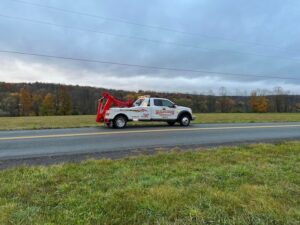
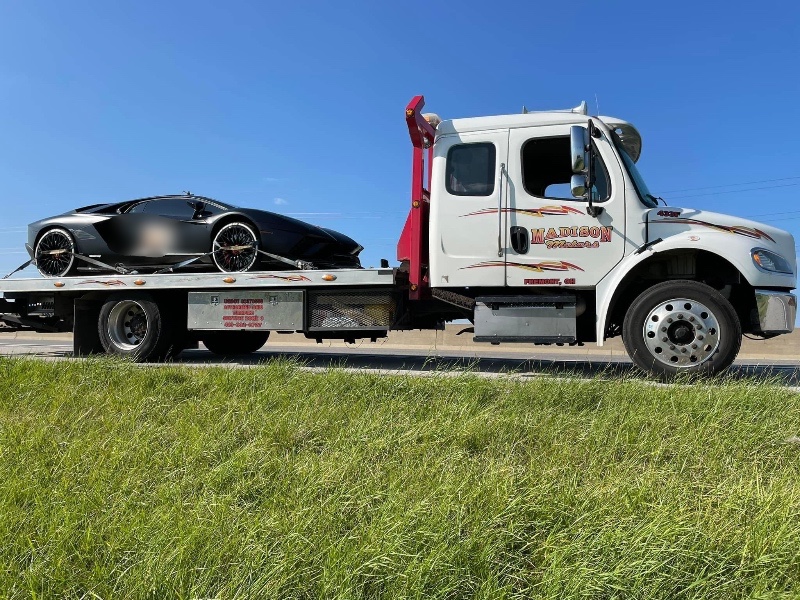
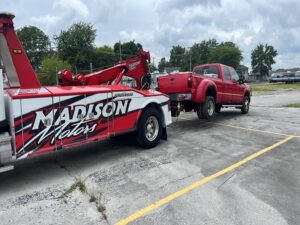
Madison Motor Towing: The Clyde Towing Team With Decades of Experience Behind It
Madison Motor Towing and Heavy Duty Semi Truck Wrecker has been serving this region since 1927, with Clyde towing calls for stored vehicles a consistent part of our family-run operation. From the Madison Street Garage that started towing service in Tiffin to our current Fremont operations, our approach has never changed: show up prepared and do the job right.
When a Clyde towing call traces back to a storage period that did not go as planned, Madison Motor Towing has the equipment and the experience to handle it. Three generations of family ownership have shaped how we work, and every call reflects that history. Call us any time and get a team that has been at this longer than most towing companies have been around.
FAQ
Is there a meaningful difference between summer and winter storage conditions?
Yes. Heat accelerates battery self-discharge and fuel oxidation, and UV exposure degrades rubber faster. Cold stiffens seals and reduces battery capacity significantly. Both extremes are harder on stored vehicles than a stable moderate temperature. The most protective storage environment is a covered, temperature-stable space out of direct sunlight and away from moisture.
Does running the engine briefly every few weeks help maintain a stored vehicle?
A short idle does not bring the engine to full operating temperature and does not charge the battery efficiently. It introduces exhaust moisture without burning it off, which can promote corrosion inside the exhaust system. A genuine drive long enough to bring all systems to operating temperature is more beneficial, but if that is not possible, a battery tender is more effective than idling at preventing the most common storage failures.
How do I know if tire flat spots will resolve on their own after storage?
Mild flat spots from a few weeks of storage usually smooth out within 20 to 30 miles of highway driving as the tire warms and returns to its normal shape. Severe flat spots from months of storage on a loaded vehicle, particularly in cold conditions, may not fully resolve. If vibration at highway speed persists after a reasonable amount of driving, the tire should be inspected for permanent deformation.
What is the risk of using a standard battery charger instead of a battery tender during storage?
A standard charger applies a constant current and should be disconnected when the battery is fully charged to avoid overcharging, which damages the battery over time. A battery tender monitors charge state and cycles on and off to maintain the battery without overcharging. For storage periods longer than a few weeks, a tender is the more appropriate tool because it can stay connected safely for months.
Can a fuel tank be left empty during storage to avoid fuel degradation?
An empty tank is generally not recommended. Air space in the tank allows moisture to condense on interior surfaces, which promotes rust and can contaminate whatever fuel is added later. A full tank combined with a fuel stabilizer provides the best protection, as it limits air exposure and slows chemical breakdown simultaneously.
What causes visible rust streaking at the wheel arches of a stored vehicle?
Rust streaking at the wheel arches usually comes from rotor rust or from surface corrosion on brake components and suspension hardware. During storage, moisture collects in these areas and promotes oxidation that can bleed outward onto the surrounding bodywork. Light surface rust from short storage typically does not penetrate deeply, but long-term storage in humid conditions can accelerate corrosion to the point where it reaches structural metal.